|
This video with John D. Liu feels to me like one of the most important documentaries I've ever seen. Liu says, " It is possible to rehabilitate large-scale damaged ecosystems. If we can, ... why don't we do that?"
1 Comment
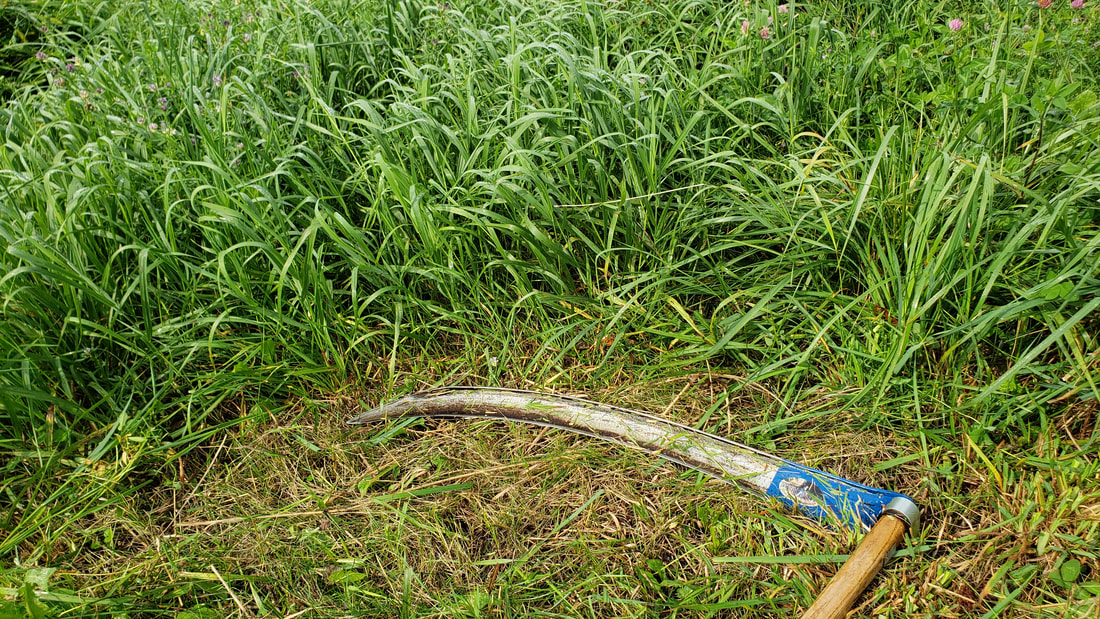
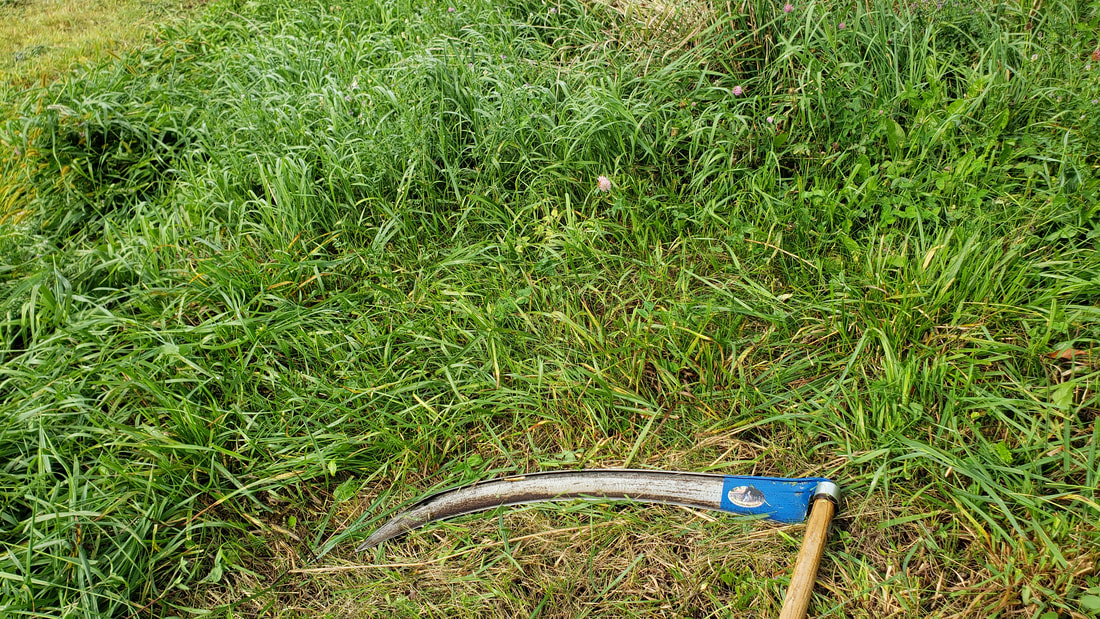
I was asked by a regenerative grass farmer who wants to raise pastured rabbits, if a scythe could cut tall grass down to a 6-inch height. He is required by state law to keep his rabbits in cages. So he wants to keep his rabbits in movable cages, with a wire mesh floor, and move them daily across a pasture. He wants to mow a 20 square foot area of tall grass down to an optimal height of 6 inches, then rake aside and gather the cut grass, pull the cage onto the cut area, and then put the fresh-cut grass inside the cage for the rabbits to eat. Basically replicating regenerative grazing with a scythe and caged rabbits. The tops of the grass gets cut at an optimal height and directly eaten, and the topsoil gets fertilized with rabbit manure. Why the 6-inch height requirement, I asked? According to this farmer, when pasture grass is grazed or cut to a minimum height of 6 inches, it is able to regenerate quicker, and over time will sequester more carbon in the soil, than grass that is grazed or cut shorter. When grass is grazed shorter than 6 inches, the corresponding amount of root dieback greatly slows the regrowth of the plant. Plus it makes it more vulnerable to dry spells. Overall, you get less carbon (organic matter) building up in the soil, he said. In the tradition of mowing with a scythe, grains were often cut high above the weeds (see video), but grass is normally cut very short. Unlike grain stalks, grass is very bendy and therefore much easier to cut with a scythe blade near the base of the plant, where it bends out of the way the least. Also, it is much, much easier to tedd and rake the hay, when the field has been cut short and clean. With a very sharp blade and good technique, you can push the limits of how high you mow grass. Grasses with stiffer stems, like timothy, brome, and foxtails, are the easiest to cut at a 6-inch height. It is simple enough to rake up the fresh cut grass, but it would be difficult to process it into well cured hay out in the field. The fresh green grass would keep snagging your hayrake and green grass would keep mixing in with the drying hay, and drying hay would get mixed in with the green grass and be lost. It would be messy. I made the quick video above to illustrate how it can be done. I just used my usual hayfield scythe set-up; my 1SR snath and an 85cm Falci 100. If I had to mow a lot of grass at a 6-inch height, I would set my grips lower and switch to a shorter and lighter 75cm Fux 2010, or Falci 100 blade. I first became interested in using hay for deep mulching my vegetable garden, back in the 1990's, after seeing a wonderful film about Ruth Stout, and her deep hay mulch gardening technique, at a Community Gardening event in Minneapolis. I had been using straw to mulch my garden beds since the 1980's, after seeing The One-Straw Revolution. I had always heard it was a bad idea to mulch with hay, because there are too many weed seeds. But what if you cut your own hay with a scythe, and didn't harvest when there were seed heads?
Back in 2006, the high fuel prices during the Iraq War, in conjunction with the Ethanol Mandate, had resulted in skyrocketing feed prices. Gas was over $5 a gallon. Diesel was even more. The duck feed I was buying had just about tripled in price. The bags of wheat, for example that I used to buy for sprouting grains for my ducks feed mix, went from $16 a bag to $46. I gradually doubled the price of my duck eggs, in order to cover the increased feed costs, but as a result I lost half my customers. Then the economy crashed and I lost 95% of the rest of them. I knew of other small farmers in my area in a same situation with skyrocketing feed prices with their organic chicken egg production. They simply decided to cut their losses, and sold all their layers to be butchered for pet food. I could not do that to my lovely Welsh Harlequin ducks, so I forged on at a loss. I ended up shoveling hundreds and hundreds and hundreds of expired duck eggs into my wood shavings compost pile. All that work, all that expense, wasted.
I decided that in order to not be at the mercy of rising fuel prices, and its effect on feed prices in the future, I should jump start my life-long dream of a “One Straw Revolution” grain field, and grow some of my own grains. Scything is a great way to start your day. I enjoy the peace and quiet, and the coolness of mowing in the early morning. Here I am up early to scythe one of my bluegrass duck's pastures. Because of all the duck water and fertilizer, the grass is similar to a dense lawn. Lush green grass like this is much easier to mow first thing in the morning while still covered with dew. The morning bird songs are enjoyable as well. For more info on making hay with a scythe, see https://onescytherevolution.com/haying.html
I personally peen all the Falci scythe blades for the outfits I sell. Falci puts a very well tapered out primary bevel on their scythe blades. A couple of finishing passes is all that is needed to sharpen and work-harden the edge, to an expert level of sharpness. Once you have mown a lot and need to peen again, because the bevel is so well tapered out, the only peening you will need to do is right at the edge with a downward hammering strike. You basically just need to touch up the edge. 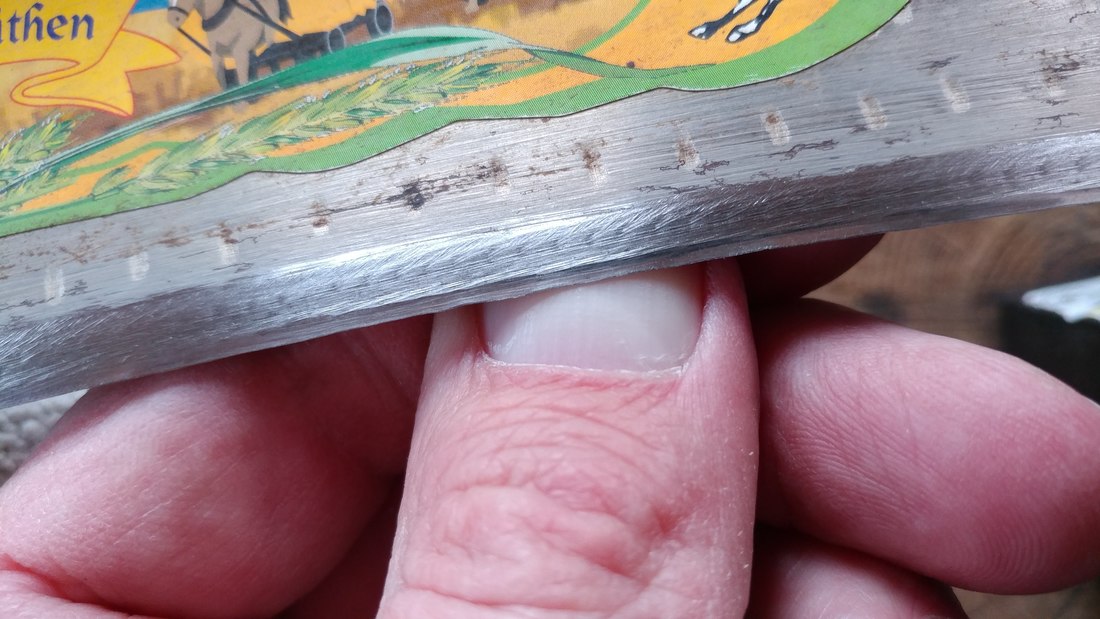 I have been experimenting with an inexpensive digital microscope to see if I can get photos of the scratch marks made on the edge of a scythe blade by all the different whetstones I sell. I would like to be able to see how the different stones compare in their effects on the edge. I peened one of my older Fux Gartensense blades, to where the edge would deflect fairly easily when a thumbnail was pressed up against it. I could not capture the amount of deflection in the photo above, so you will have to take my word for it. It was a nicely peened edge, though not quite as thin as the one in the video. I wanted the edge to be thick enough not to get chewed away by the coarser stones. Next I marked off 8 sections with some tape, and then I proceeded to hone each section with a different scythe stone. You can see photos of the whetstones I used on my Whetstones page. I honed each section bench-style, with a diagonal, rolling, grinding motion, on the bevel side only, until each stone had raised a burr.. I removed the burr by honing on the back (underside) of the blade, honing towards the edge with the flat side of the stone, to cut off the burr without raising another one on the bevel side. Next I wiped all the sludge off the blade with a wet paper towel and then dried it with a paper towel. 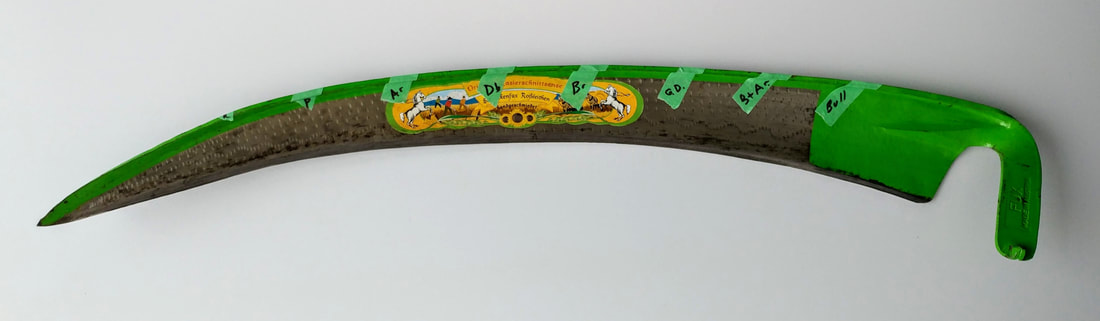 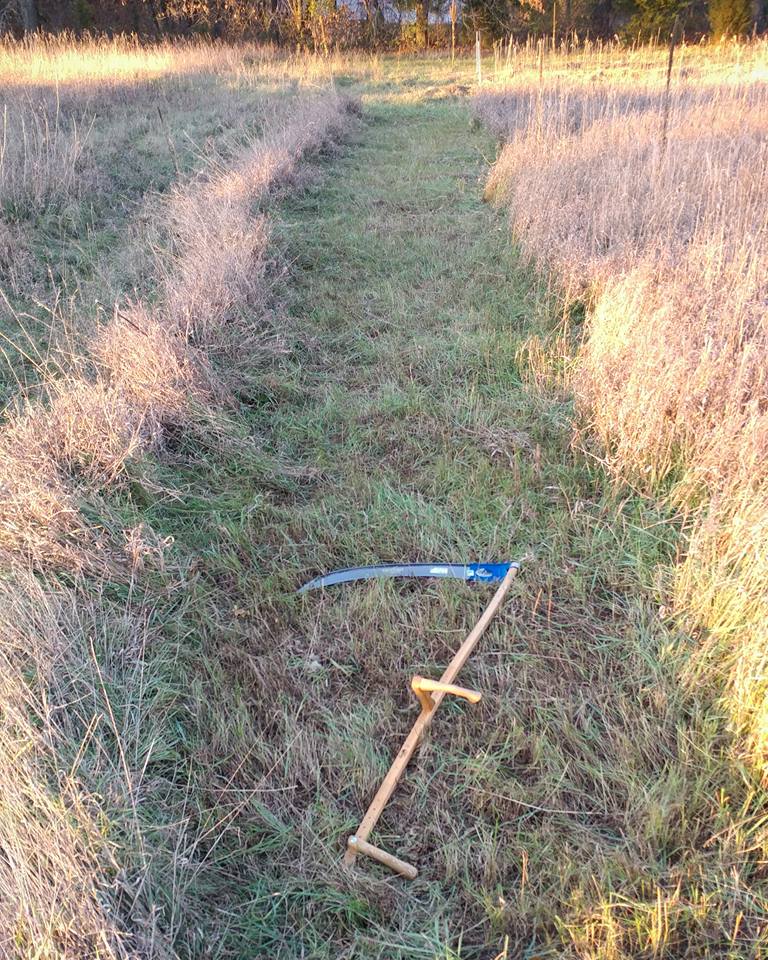 Winter is coming, but don't put away your scythes away just yet. This is the time of year that I like to mow brome grass at the straw stage, for use as animal bedding and mulch. It's great for mulching garlic. My favorite blade for this is the 85cm Falci 100. The 100 is formed to slide well over a bumpy field, and so it leaves rather high stubble. This works great with a prime upright hayfield, but it also works great for mowing brome in the late fall for straw. Whereas a flatter blade like the FUX 2010 blade, which hugs the ground and leaves short stubble, would mow everything and shave the ground clean, the Falci 100 will leave a lot of the short green grass behind unmowed. It takes a lot less effort to mainly mow just the dry straw rising above the green grass, than it takes to mow everything clean. Since I want to use the harvested grass as straw, I would rather have more dry matter and less green grass in the mix. The ease of mowing brome at this time of year is a lot of fun!
|
Botan Anderson Archives
March 2023
Categories
All
|
 RSS Feed