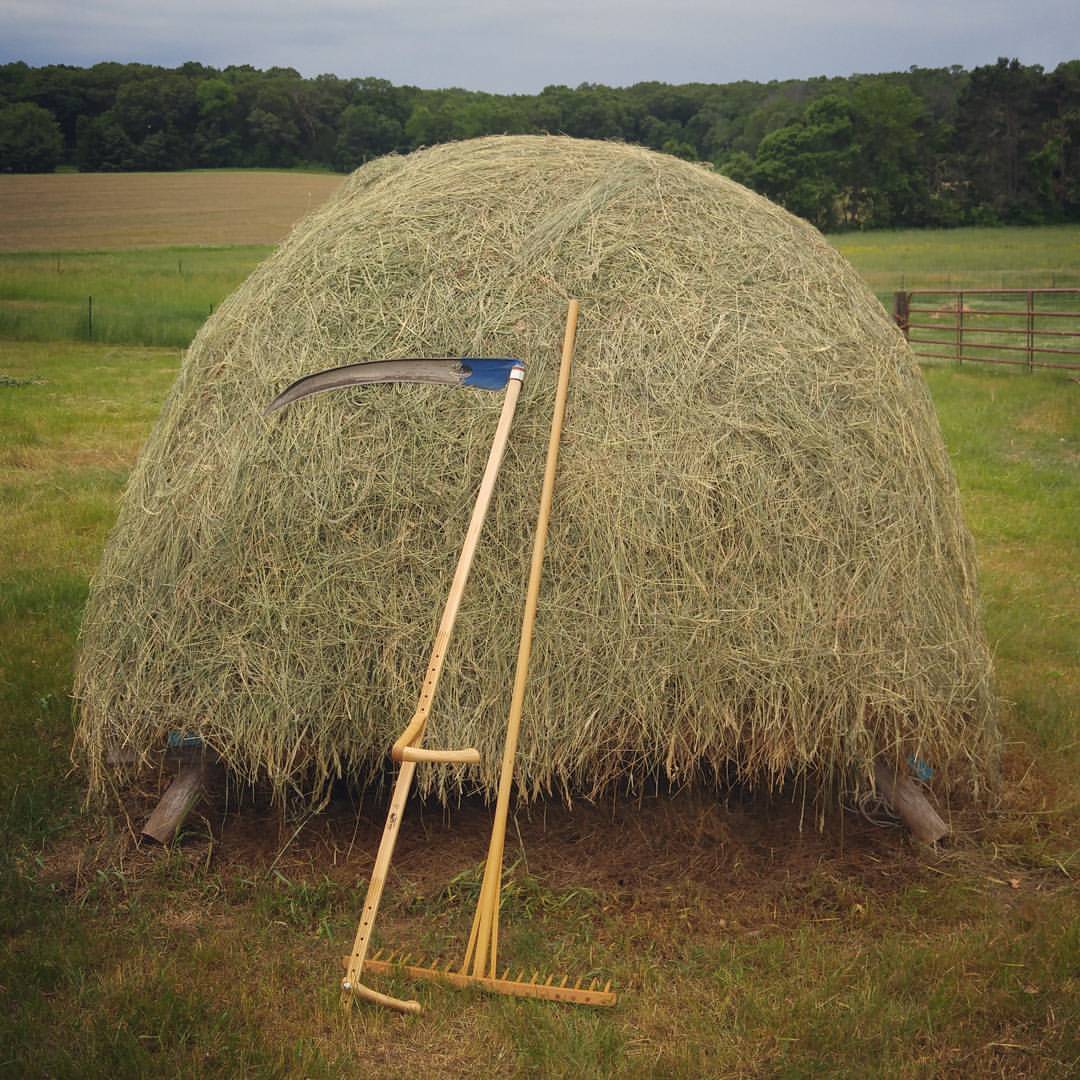
 It's been a while since I have posted an update on my experiments with my pyramid haystack system. I've been working with beefing up the haystack frame with cedar posts, and covering the stack with used billboard tarps. To follow the whole thread, you can start at the first haystack blog post. For this update I posted three new videos on YouTube showing how I build up my pyramid haystacks. I also have the videos posted at the bottom of this blog entry. Over the years I have often been asked how I get the shape of the stack to come out so well. It seems to be something people are having trouble with. Like many of my previous scythe videos, I don't shy away from showing how the work gets done in real time, so I don't speed up the footage. My intent is to give a realistic sense of the time and amount of work involved. But don't worry, my Siamese cat does his best to keep you entertained!
2 Comments
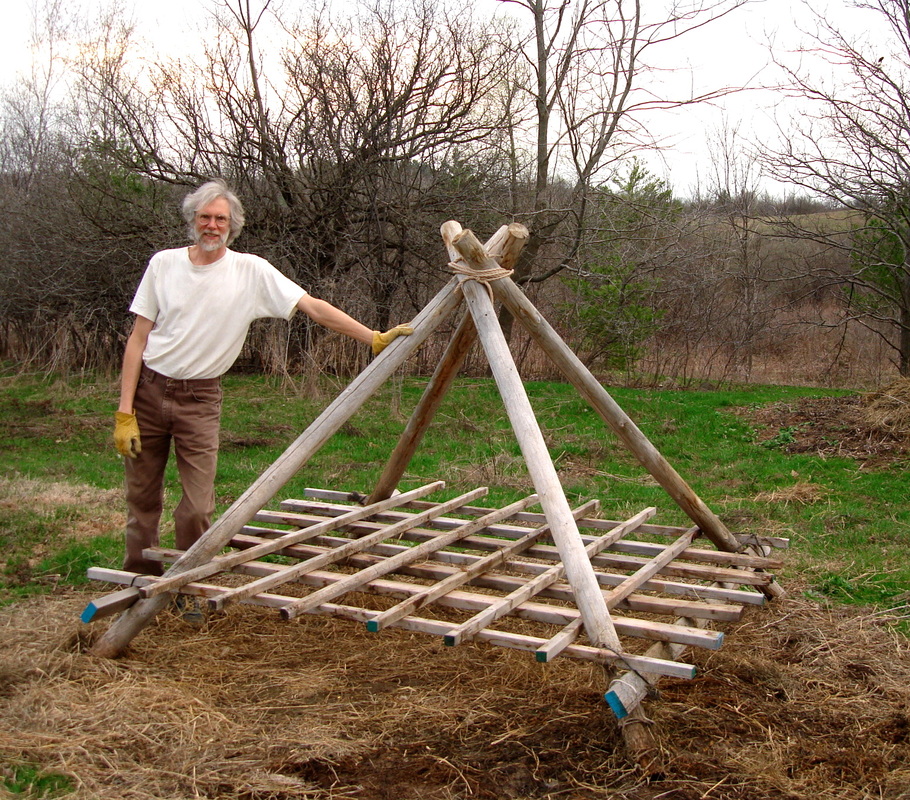 As some of you know, I have had to move off my farm. A long, dark, and bitter story, that I will save for another time. This is the last and final thing that I moved off my farm yesterday. My friends and family think I was nuts to go back and get it, but it's my favorite "invention" from my farm. ("Invention" like in re-inventing the wheel. Haystack frames have been around for a long time, of course.) It was the latest and most successful evolvement of my Pyramid Haystack frames. It was in continues use for over 5 years, and left outside the entire time. All the wood and ropes are still completely sound. I hope to use it again somewhere this summer, and for many to come.
In 2006 I attended the International Scythe Symposium, hosted by the Vido family on their farm in New Brunswick, Canada. The event was a delight for a photographer. I took a lot of pictures. I had posted some of them in the photo gallery on my farm website before, but in an awkward format. Since it's still winter here, and there's not a whole lot of mowing going on, I thought I'd revisit the Symposium with this blog, and re-post the pictures with the great multimedia features of this Wordpress blog. The slide show above is of the mowing workshops at the Symposium. Hope you enjoy it. Please comment and feel free to ask questions. I will add more text and photos over time.
I don't have a real barn yet on my farm. Still hope to have a nice old-fashioned barn with a hay-mow for loose hay someday, but in the meantime I've had to turn to very traditional methods of stacking my scythe cut hay and straw outdoors. I make two types of haystacks here at my farm: 1. A Romanian-style haystack, which consists of dried hay stacked upon a bed of tree branches, around a very tall, central pole, and stacked very high. 2. A tarp-covered, Pyramid-framed haystack of my own design. 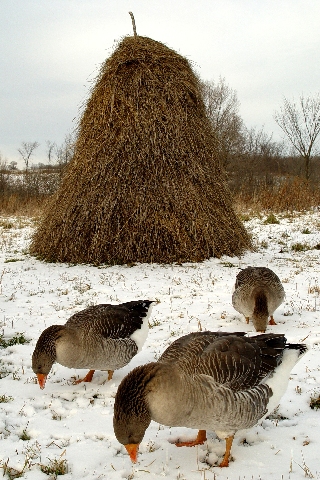 1. The Romanian-style haystack is made by stacking dried grass hay upon a bed of branches (4 pallets would work), around a very tall, central pole, which is braced with a tri-pod, and then the hay is stacked very high. The outside of the stack is then raked with a hayrake, to form a thatched outer shell. A very high and narrow, round shape, works best for this type of haystack. No need for a tarp covering. If formed and raked properly, the outer layer matts down into a very breathable, yet weather-proof shell. Hay stored this way, keeps a long time.
The disadvantage though, comes when you want to use the hay. As soon as you break the outer shell and remove only some of the hay, the rest of the stack is then vunerable to the weather. Traditionally, all the hay in the whole stack would be hauled away to the barn, or some other form of covered shelter. Another disadvantage is that it has to be constructed in it's entirety at one time. Which means you have to have all your hay ready at one time (which takes a tremendous amount of hay), because the hay itself needs to be shaped and combed to become the "roof". With my Pyramid haystack, you can keep adding hay over time as it's ready, because it's "roof" is a removable tarp. If you want to learn about the Romanian style of haystack, there are excellent pictorials at http://www.hayinart.com/003028.html and http://leafpile.com/TravelLog/Romania/Farming/MakingaHaystack/MakingHaystack.htm . The people at Leaf Pile, are also publishing a photobook with essays on the rural life of Northern Transylvania, called "The Color of Hay: the Peasants of the Maramures" . It will be available in October 2010. You can order it at http://colorofhay.com/ A picture is worth a thousand words! |
Botan Anderson Archives
March 2023
Categories
All
|
 RSS Feed