What is an "Austrian" Scythe Blade?
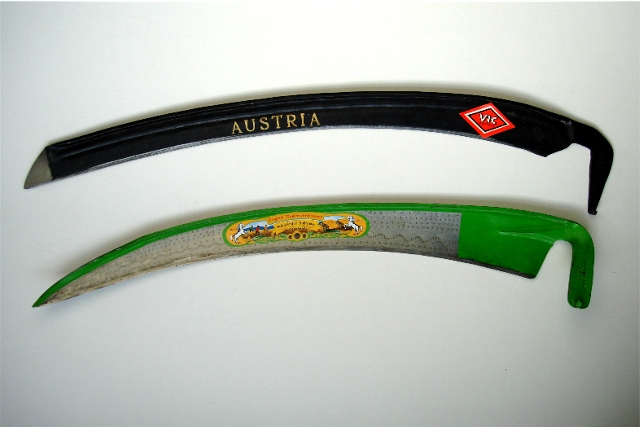
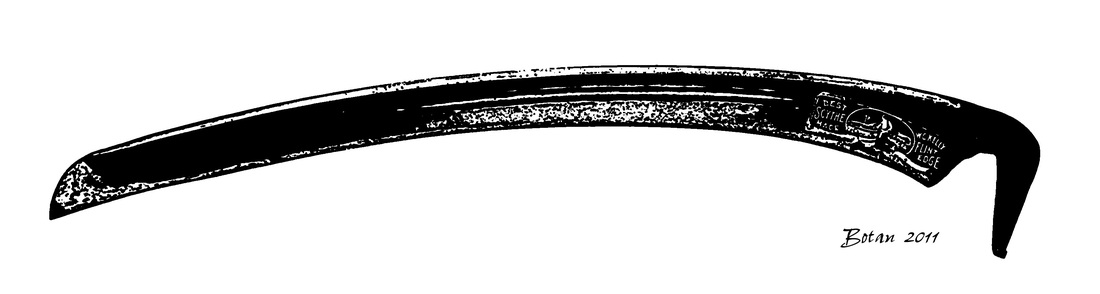
Pictured here are two 28 inch long scythe blades. Both of these blades were made in Austria. The top blade, however is actually an American-style scythe blade. It was made in Austria, but It is not an "Austrian" style of blade. The bottom blade is an Austrian-style scythe blade, plus it's made in Austria. Both of these types of blades are often sold as genuine Austrian scythe blades here in the USA. While that's true in a sense, it often creates confusion for new customers. There aren't any scythe blade manufacturers in America, anymore. They went out of business a long time ago, so American-style blades are now only being made in Austria.
Blade Design: Austrian vs. American
The American style blade on the right, is thicker and is made out of a harder steel that must be sharpened on a grindstone. It has a pointy tang, that's in line with the blade. The American style blade only has one curve, and that is it's crescent shape. If you lay the blade on a table, it will lie as flat as the table.
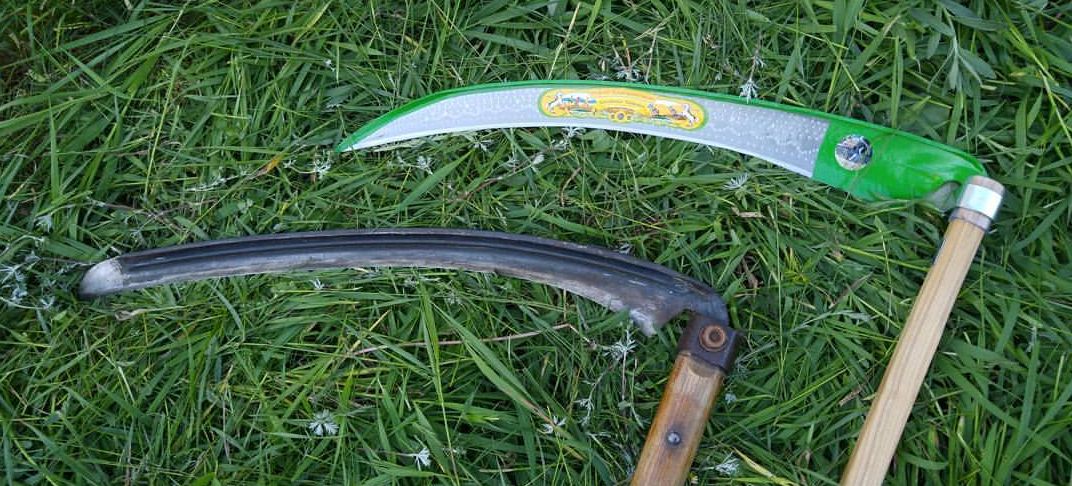
The Austrian blade on the left, is the product of a much more sophisticated metalworking process. It is made of a somewhat softer and thinner steel, and gets it's strength from its THREE curves:
1. The obvious CRESCENT shape.
2. The ROCKER- a curve that runs lengthwise and lifts the tip off of the ground.
3. The BELLY- a curve from side-to-side, that has the effect of lifting the cutting edge slightly off of the ground.
If you lay it on a table, it floats on it's belly, and all four sides are lifted slightly off the table. It is light weight and has a wide tang that is raised. The steel is malleable enough to sharpen it by cold-hammering the cutting edge thin, with a peening hammer and anvil.
We sell Austrian-style blades, and they are hand-forged in Austria by a factory that has been making them since 1540.
The Austrian blade on the left, is the product of a much more sophisticated metalworking process. It is made of a somewhat softer and thinner steel, and gets it's strength from its THREE curves:
1. The obvious CRESCENT shape.
2. The ROCKER- a curve that runs lengthwise and lifts the tip off of the ground.
3. The BELLY- a curve from side-to-side, that has the effect of lifting the cutting edge slightly off of the ground.
If you lay it on a table, it floats on it's belly, and all four sides are lifted slightly off the table. It is light weight and has a wide tang that is raised. The steel is malleable enough to sharpen it by cold-hammering the cutting edge thin, with a peening hammer and anvil.
We sell Austrian-style blades, and they are hand-forged in Austria by a factory that has been making them since 1540.
Snaths: Austrian vs. American-style
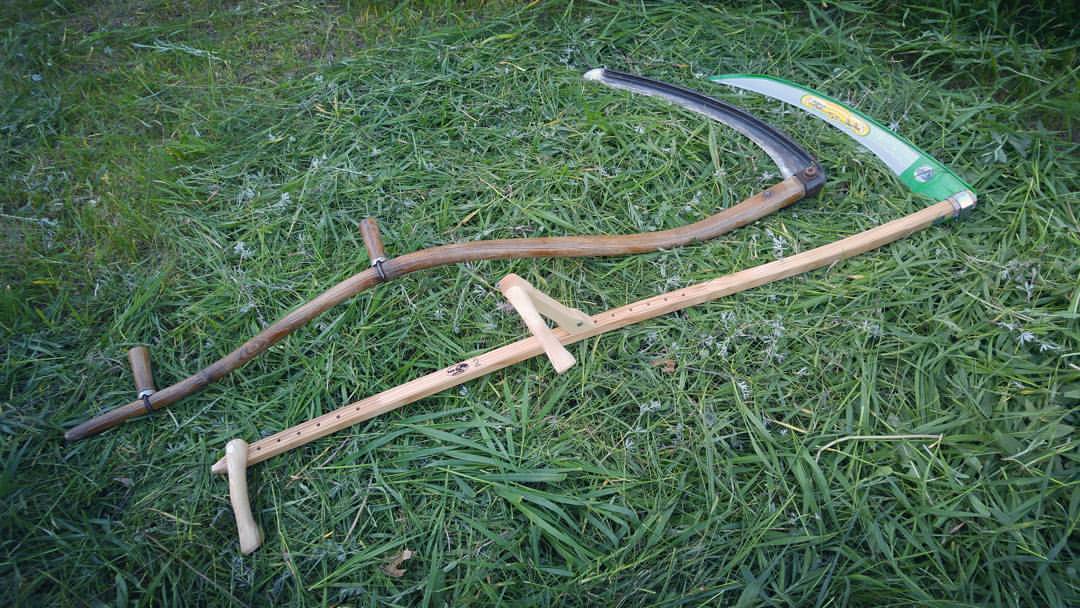
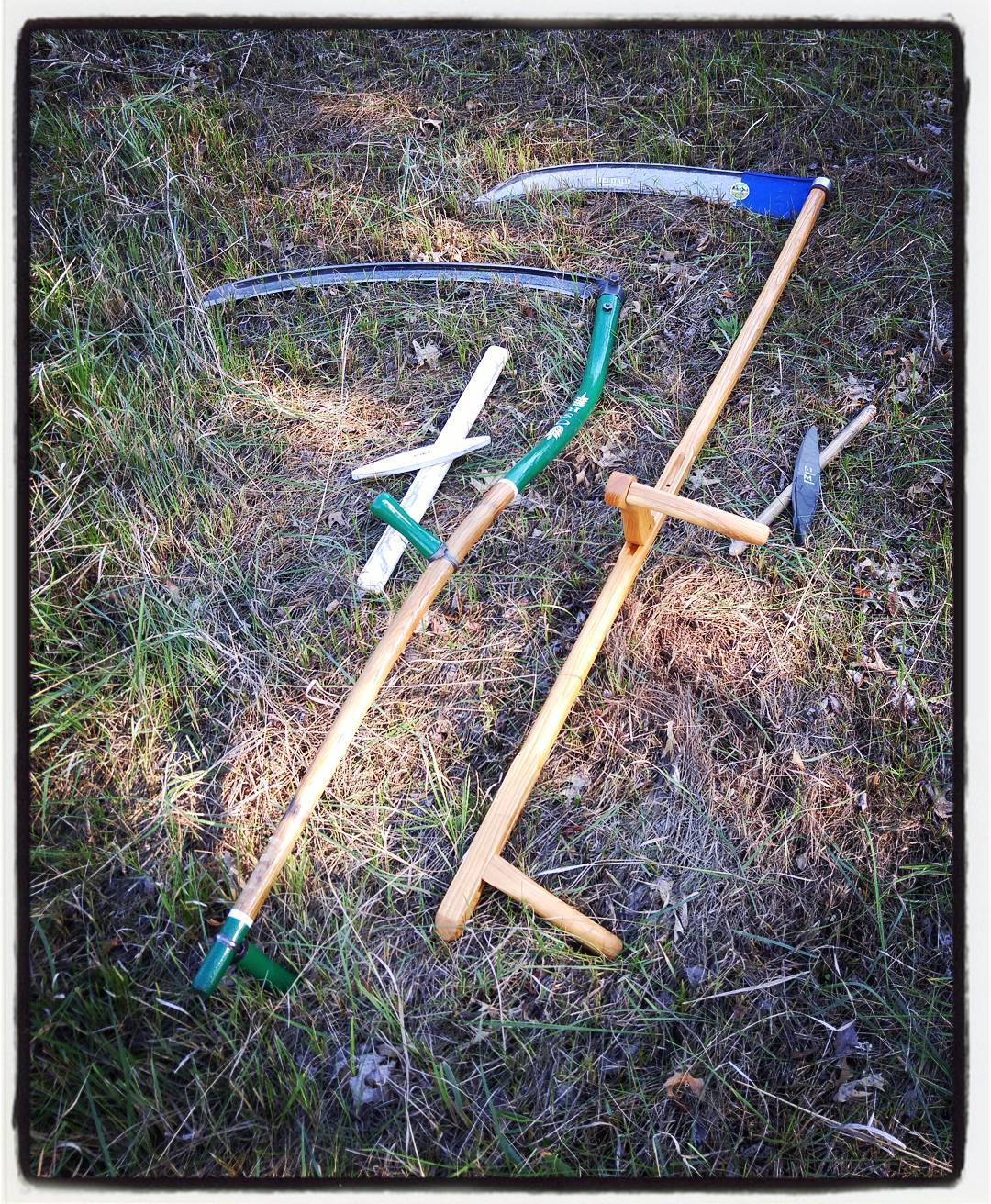
The scythe on the left is an Austrian-style scythe; the scythe on the right is an American-style scythe. The scythe on the right is the type that has given the scythe such a bad reputation in this country. Whenever I mention to people that I sell scythes, they often say "Oh, my grandfather had one. He used to make me mow the tall grass and weeds with it. It was SO MUCH WORK! I hated it!" The style of scythe that they are referring to is the American-style scythe on the right. Being very heavy, and awkward to use, (and seldom sharp), it made mowing a very labor-intensive process, indeed! I think it did much to contribute to the great enthusiasm Americans now have for powered mowers!
The logic behind the American-style design, quite frankly tries to "fudge" the laws of geometry. Since the blade is crescent shaped, it should move in a half-circle in front of you, in the same plane as the ground. Yet because the tang is completely flat, you would have to practically bend over far enough to touch your toes, to do so! The American-style scythe blade is actually designed to slide over the ground on the back of it's rib, but this tilts the crescent shape up and out of the plane of the half-circle that it should move in, on the ground. Hence most people, swing it in the plane that it's set at, at an acute angle to the plane of the ground! In other words, they swing it like a golf club or a hockey stick.This means that they only cut a small patch of grass in front of them, with every heavy stroke of the scythe! Yes, it is a lot of work to mow like that! Even more so with a dull blade.
The true "Austrian" scythe, on the other hand, weighs much less than the American one. The blade is lightweight, and has a raised tang, so that you can remain upright while moving the blade in an arc (in the same plane as the ground), and the snath can be less curved, and much lighter than the American-style snath. With the 3 curves of the Austrian scythe blade, you don't even have to hold it up off the ground, while mowing. You can just let it slide over the ground, and cut a swath of grass in a full arc in front of you. An arc 1.5 times your body's height, in length! The true Austrian-style scythe is a much more efficient, and effective mowing tool than most Americans can even conceptualize!
The logic behind the American-style design, quite frankly tries to "fudge" the laws of geometry. Since the blade is crescent shaped, it should move in a half-circle in front of you, in the same plane as the ground. Yet because the tang is completely flat, you would have to practically bend over far enough to touch your toes, to do so! The American-style scythe blade is actually designed to slide over the ground on the back of it's rib, but this tilts the crescent shape up and out of the plane of the half-circle that it should move in, on the ground. Hence most people, swing it in the plane that it's set at, at an acute angle to the plane of the ground! In other words, they swing it like a golf club or a hockey stick.This means that they only cut a small patch of grass in front of them, with every heavy stroke of the scythe! Yes, it is a lot of work to mow like that! Even more so with a dull blade.
The true "Austrian" scythe, on the other hand, weighs much less than the American one. The blade is lightweight, and has a raised tang, so that you can remain upright while moving the blade in an arc (in the same plane as the ground), and the snath can be less curved, and much lighter than the American-style snath. With the 3 curves of the Austrian scythe blade, you don't even have to hold it up off the ground, while mowing. You can just let it slide over the ground, and cut a swath of grass in a full arc in front of you. An arc 1.5 times your body's height, in length! The true Austrian-style scythe is a much more efficient, and effective mowing tool than most Americans can even conceptualize!
The "Austrian" and the "American" Scythe in Action:
The Austrian scythe in action: Above is a video of me mowing with an Austrian scythe. I am using a 32" antique scythe blade made by the Redtenbacher factory of Austria, for the Pennsylvania Dutch, here in the USA. For scale, I am 6'5" tall, and have a 10ft wide scythe stroke. I'm mowing fully mature orchard grass and heavy red clover, that has all gone to seed. It's brown on top, and green at the base, and storms have blown it over, and flattened it somewhat.
The American scythe in action: Here is a link to a charming video of some highly skilled, old-timers, using "American"-style scythes (or Canadian or British, all very similar). http://www.youtube.com/watch?v=no_M7Wubo1A Their blades are actually sharp, and they are mowing very effectively, under somewhat difficult mowing conditions. The mature grass had been flattened down by a storm, requiring more finesse to mow. If you have an American style scythe, this video gives you an idea of how they are supposed to work.
Sharpening: American vs. Austrian
Grinding
The American-style of scythe blade originated in England, and is the result of the very simple metal working capabilities of old northern Europe. It's design is based on the simple crescent shape that a common blacksmith could pound out on an anvil, and grind to a sharp edge. It is a design used throughout the northern European countries from Ireland to Scandinavia. They did not have very good local steel, and they didn't have mechanical trip-hammers, and so needed to make the blade thicker, harder, and simpler than an Austrian blade. The harder the steel, the sharper an edge could be ground, and the longer the edge would stay sharp. In more modern times, good blades were advertised for the hardness of their steel. But this also made the blade somewhat brittle, and you often see old American scythe blades with the tip snapped off. With industrialisation, more efficient means of mass-production were developed, but the basic design was not changed a whole lot.
Contemporary American scythe blades that are now only made in Austria, are made of the same steel that the Austrian blades are, and they are also hand forged. But they are still made thick and flat, according to the American pattern. It is made of such thick and heavy metal, that it should be sharpened by grinding the edge on a water wheel grindstone. The edge is ground 2/3 on the top side, and 1/3 on the bottom side. This creates the correct bevel. Not many of these grindstones are around any more. Not many American scythe blades are sharp any more, either! But even a sharp one, can not get as sharp as an Austrian scythe blade.
Peening
The Austrian scythe blade is produced by a much more sophisticated metal working process. Austria is renowned for it's high quality steel. Austria was also influenced very early, by the sophisticated metal working skills of the Ottoman empire. Austria had lots of hydro-power, and utilized water-powered, mechanical trip hammers, as early as the 1400's for their scythe factories. All this enabled the blacksmiths to use a more malleable steel, and work a scythe blade to a much higher degree, and to develop very sophisticated blade designs, and to mass produce them. The genius of using a more malleable steel, and giving it strength by curving it in 3 planes, is that the metal at the edge is thin enough and malleable enough, to cold hammer the edge thin, to sharpen it. This process is called peening the scythe blade. This thins out the metal at the edge so fine, that a very fine, hand-held whetstone can do the final honing. It also work-hardens the cutting edge, so that the cutting edge is made simultaneously, both extremely sharp and durable.
In conclusion:
For curiosity's sake, whenever I teach a scythe workshop, I let people try out my American scythe with a brand-new blade. They are always astonished by how much more work it is to use the American scythe.
If you mowed with an American scythe and then switched to an Austrian scythe, it would be like switching from a heavy, discount-store, one-speed bicycle, to a top-of-the line, 18-speed bicycle from a specialty bike shop. Sure you have to wear toe clips, and learn how to shift the gears, but in terms of energy expended, versus work accomplished, the 18-speed bike is worth it. If you were to start a commute-to-work by bicycle program, the success of your program would be determined by the quality of bikes that were used, and the distance of the commute. The better your bike, the further you can easily commute. This is a good analogy for using a scythe for small scale ag. If you just want to whack down some weeds, an American scythe, or a dull and/or poor quality Austrian scythe might suffice. If you seriously want to use a scythe to make hay for a couple of family cows, or small flock of sheep, etc., or mulch for a large garden, you need some good equipment, and you need to learn how to use it properly. This is the niche that I hope to fill with this One Scythe Revolution website.